The common-sense case for nationalizing US elections
—
I did not arrive at this argument as a theorist or as a commentator looking for a clever angle. I arrived at it through the wreckage of 2020.
After I investigated the November 2020 election in Arizona and Nevada, the Department of Justice subpoenaed me. In February 2023, I spent six and a half hours testifying before a federal grand jury in Washington, D.C. That experience did not change my political outlook. It changed my sense of how exposed the country has become — and how unwilling key institutions have been to confront the exposure directly.
Do Americans still govern themselves, or do we merely perform self-government while hostile forces — foreign and domestic — shape outcomes behind a screen?
The debate returned with new urgency this week. The Washington Post reported Thursday that election integrity activists are urging the Trump administration to issue an executive order on elections. It’s about time. Executive action has become the only plausible instrument for a rapid national response, because the states have entrenched incentives to resist meaningful reform and foreign enemies have worked diligently to undermine and defeat us.
For anyone with eyes to see, war has come. It has not arrived in the form Americans expect when they hear the word. It does not always appear wearing uniforms, wielding declarations, or mobilizing divisions. It arrives through political warfare, cyber capabilities, influence operations, and domestic agitation. It arrives through a border that stops functioning, a culture that stops teaching civic loyalty, and an election system that produces outcomes a large share of the country considers illegitimate.
A global conflict now runs through the heart of America’s public life. Communist China and other hostile regimes mean the destruction of the United States, and they pursue that goal with patience, strategy, and resources.
Alongside that global conflict, a domestic conflict has hardened into something close to open civil war, with one side committed to sovereignty, law, and national continuity, and the other side increasingly willing to use institutional leverage, street agitation, and demographic transformation to break the existing order.
This domestic conflict matters for a practical reason: It makes free and fair elections difficult if not impossible to conduct in 2026 and 2028 absent radical steps to secure them.
Can America have a fair election in 2026?
Three fronts define the challenge. First, the United States must conduct elections that Americans can recognize as legitimate. Second, Immigration and Customs Enforcement must regain the ability to deport the millions of illegal aliens who entered the country during the Biden years, despite organized resistance. Third, foreign enemies must be denied the ability to wage war on America through cyber sabotage, influence operations, and electoral interference.
These fronts converge on one question: Do Americans still govern themselves, or do we merely perform self-government while hostile forces — foreign and domestic — shape outcomes behind a screen?
Start with elections, because everything else depends on them.
Self-government requires two things that cannot be faked. First, a border defines citizenship. Second, an election defines consent.
A republic cannot survive without both. Yet Americans now live under conditions that invite doubt about each: a border that failed catastrophically, and an election system that many citizens no longer trust.
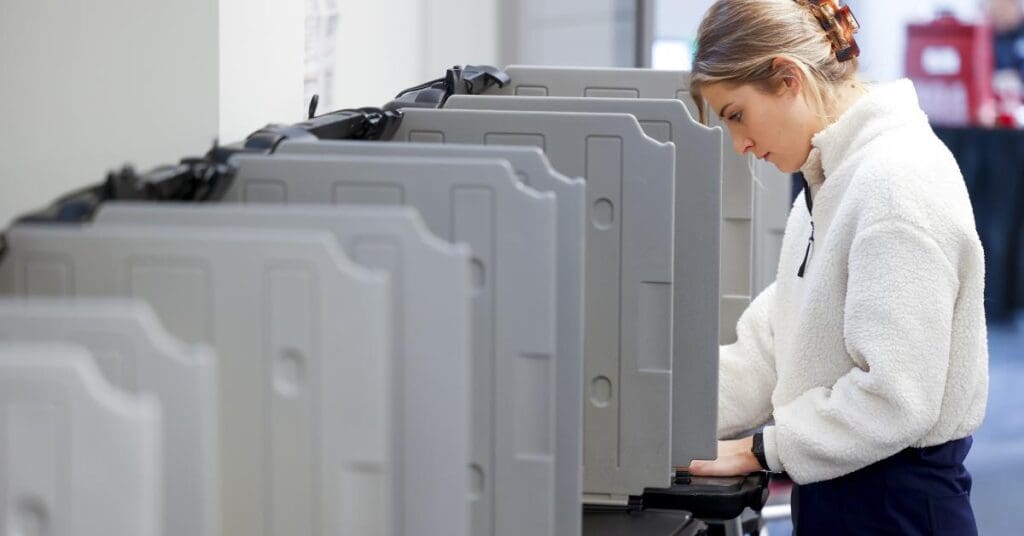
Fair elections demand friction. They demand procedures that annoy activists and frustrate bureaucrats. They demand a system that ordinary citizens can understand. A voter should show identification, vote on a paper ballot, and watch that ballot be counted by human beings under observation by other human beings.
Perfection will never exist. The point is not perfection. The point is transparency, auditability, and public confidence grounded in procedures citizens can see and grasp.
For most of American history, paper ballots provided that confidence. Americans knew what happened in the counting room because the counting room did not function like a proprietary black box. Election modernizers sold the country a different idea: Computers make things fast, efficient, and secure. The experience of the last decade, culminating in 2020, has left that promise in ruins.
RELATED: ‘Dead on arrival’: Chuck Schumer says Dems will ‘go all out’ to defeat voter ID bill
Photo by Bill Clark/CQ Roll Call/Getty Images
A massive intelligence failure
Since November 2020, the corporate legacy media has insisted that the U.S. election system operates as “absolutely secure” and that widespread fraud does not exist. That claim collides with common sense.
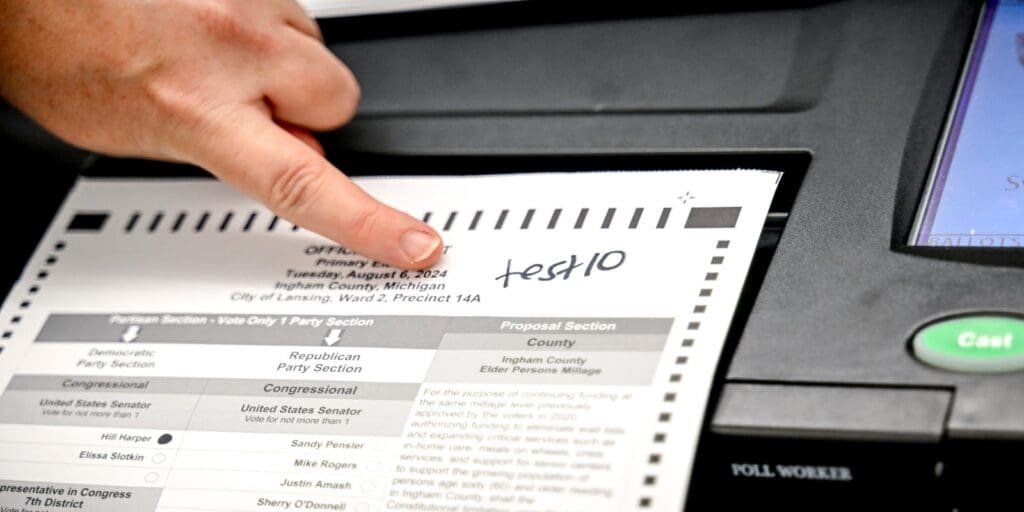
The vast majority of Americans now vote through an election ecosystem built on machines, scanners, tabulators, centralized databases, and software layers that few officials can explain and fewer citizens can independently audit. This ecosystem does not eliminate fraud. It relocates fraud into places the public cannot easily see.
Electronic voting systems invite manipulation because they rely on computers. Computers obey code. Code gets written, altered, updated, patched, and maintained by people with incentives, biases, and vulnerabilities. Any system dependent on code and opaque tabulation invites distrust — and it invites actors with resources to exploit it.
Hardware alone raises the first national security issue. Election machines rely on electronic components manufactured in communist China or Taiwan. China is an enemy nation. A hostile regime’s manufacturing ecosystem should not sit inside critical infrastructure, and elections sit at the heart of critical infrastructure. When Americans hear that the parts driving their voting system originate in China, many react with disbelief. That reaction is rational.
Software raises a second issue. Major election technology has been developed, maintained, or designed across foreign jurisdictions — Venezuela, Canada, Serbia — with American developers in the mix. Even when parts of that reporting prove disputed or exaggerated in public debate, the broader fact remains: A modern electronic election system creates a sprawling supply chain of hardware and software dependencies that pushes election integrity far outside the direct control of any voter, precinct worker, or local official.
An enemy regime does not need to ‘flip votes’ to win. It can accomplish its goals by shredding trust, delegitimizing outcomes, and pushing Americans toward internal conflict.
Ownership and investment raise a third issue. The purchase and financing structures surrounding major election vendors have generated persistent public questions, including questions about foreign investment exposure and the presence of overseas investors with legal obligations to their own regimes. The press largely refused to investigate those questions in any serious way after 2020. Instead, it treated the questions themselves as illegitimate — which encouraged distrust rather than resolving it.
How did such systems enter American elections in the first place?
The answer points to intelligence and counterintelligence failure.
Modern warfare is not limited to bombs and bullets. Modern warfare includes political warfare, cyber operations, influence campaigns, and the exploitation of social fractures. Any hostile regime with the ability to damage American legitimacy has an interest in doing so. An enemy regime does not need to “flip votes” to win. It can accomplish its goals by shredding trust, delegitimizing outcomes, and pushing Americans toward internal conflict.
U.S. counterintelligence should treat election seasons as high-value windows for hostile activity, because elections present the most valuable target in American political life. Yet the United States behaved as if such threats belonged in the realm of conspiracy rather than standard national-security planning.
Warnings existed before 2020. HBO’s 2020 documentary “Kill Chain: The Cyber War on America’s Elections,” produced primarily in 2019 by Finnish computer programmer and documentarian Harri Hursti, laid out vulnerabilities in electronic voting systems.
The film included Senators Elizabeth Warren (D-Mass.), Amy Klobuchar (D-Minn.), and Ron Wyden (D-Ore.), each of whom criticized election technology and raised concerns about trust, auditability, and system integrity. The documentary’s premise focused on the fear that Russia would steal the election for Donald Trump. In other words, prominent Democrats publicly argued that electronic systems could not be trusted — right up until those arguments became politically inconvenient.
The documentary’s partisan framing does not matter. The underlying point does: A computer-based system can be manipulated, and the mere possibility of manipulation creates a legitimacy crisis for any contested outcome. A republic cannot function when half the country believes the outcome was engineered by an opaque system.
The ‘most secure electio